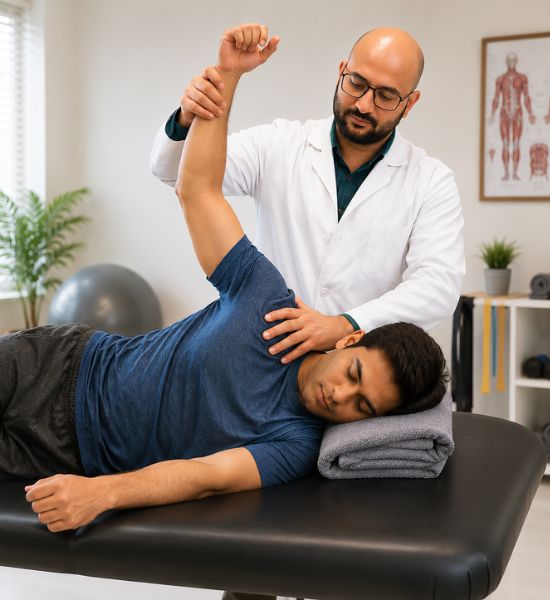
Lumbar Spondylosis Treatment in Gurugram
At UM Physiotherapy, we provide evidence-based Lumbar Spondylosis Treatment in Gurugram designed to reduce pain, improve flexibility, restore movement, and enhance overall spinal health.
Under the guidance of Dr. Mohd Umar Mukhtar Qurashi, a Gold Medalist Physiotherapist and HCPC Registered Physiotherapist (United Kingdom), patients receive personalized rehabilitation programs focused on long-term recovery rather than temporary symptom relief.
What is Lumbar Spondylosis?
Lumbar Spondylosis refers to age-related wear and tear affecting the lumbar spine (lower back). Over time, the discs, joints, ligaments, and vertebrae undergo degenerative changes that may lead to pain, stiffness, and reduced mobility.
It is often referred to as:
- Lower Back Arthritis
- Lumbar Degeneration
- Lumbar Osteoarthritis
- Degenerative Spine Disease
While aging is a major factor, lifestyle habits often influence the severity and progression of symptoms.
Understanding the Lumbar Spine
The lumbar spine consists of five vertebrae located in the lower back.
The lumbar spine is responsible for:
- Supporting body weight
- Maintaining posture
- Allowing bending and twisting movements
- Protecting spinal nerves
- Absorbing forces during daily activities
Because it carries much of the body’s weight, the lumbar spine is particularly vulnerable to stress and degeneration.
What Causes Lumbar Spondylosis?
Several factors contribute to the development of Lumbar Spondylosis.
Age-Related Changes
Natural degeneration occurs over time as spinal discs lose hydration and flexibility.
Poor Posture
Improper sitting and standing posture place excessive stress on the lower back.
Sedentary Lifestyle
Lack of movement weakens supporting muscles and increases spinal stress.
Prolonged Sitting
Office workers and remote professionals often spend long hours sitting, increasing the risk of lower back dysfunction.
Repetitive Lifting
Frequent lifting, bending, and twisting can accelerate degeneration.
Excess Body Weight
Additional weight places increased pressure on the lumbar spine.
Previous Back Injuries
Old injuries may contribute to ongoing degeneration and pain.
Common Symptoms of Lumbar Spondylosis
Symptoms may develop gradually and worsen over time.
Lower Back Pain
The most common symptom experienced by patients.
Morning Stiffness
Many patients notice increased stiffness after waking up.
Pain While Sitting
Prolonged sitting often aggravates symptoms.
Reduced Flexibility
Bending, twisting, and lifting may become difficult.
Muscle Tightness
Muscles around the lower back often become tight and overactive.
Pain During Walking
Some individuals experience discomfort after walking for extended periods.
Leg Pain or Sciatica
In some cases, nerve irritation may cause pain radiating into the leg.
Learn More: Sciatica Treatment in Gurugram
Stages of Lumbar Spondylosis
Early Stage
Occasional stiffness and mild lower back discomfort.
Moderate Stage
More frequent pain episodes and reduced mobility.
Advanced Stage
Persistent pain, stiffness, and possible nerve-related symptoms.
These may include:
- Leg Pain
- Tingling
- Numbness
- Weakness
Professional Lumbar Spondylosis Physiotherapy becomes increasingly important at this stage.
Can Lumbar Spondylosis Be Reversed?
Many patients ask whether Lumbar Spondylosis can be completely cured.
While structural degeneration cannot always be reversed, symptoms can often be significantly improved through physiotherapy and lifestyle modifications.
Treatment focuses on:
- Reducing Pain
- Improving Mobility
- Strengthening Muscles
- Improving Posture
- Preventing Progression
- Enhancing Quality of Life
How Physiotherapy Helps Lumbar Spondylosis
Physiotherapy for Lumbar Spondylosis is one of the most effective non-surgical treatment options.
Pain Management
Reducing discomfort and improving daily function.
Mobility Restoration
Improving spinal flexibility and movement.
Core Strengthening
Strong muscles help support the lumbar spine.
Posture Correction
Reducing unnecessary stress on spinal structures.
Functional Rehabilitation
Helping patients return to daily activities safely.
Long-Term Prevention
Reducing recurrence and future flare-ups.
Our Lumbar Spondylosis Rehabilitation Approach
At UM Physiotherapy, every patient receives a customized treatment plan.
Detailed Assessment
Evaluating posture, movement, flexibility, strength, and functional limitations.
Manual Therapy
Improving joint mobility and reducing stiffness.
Stretching Programs
Reducing muscle tightness and improving flexibility.
Core Strengthening Exercises
Building spinal stability and support.
Postural Training
Correcting faulty movement patterns and daily habits.
Home Exercise Program
Supporting long-term recovery and spinal health.
Why Early Treatment Matters
Ignoring Lumbar Spondylosis may lead to:
- Chronic Lower Back Pain
- Reduced Mobility
- Increased Stiffness
- Poor Posture
- Reduced Physical Activity
- Muscle Weakness
- Nerve Irritation
- Reduced Quality of Life
Early intervention often provides better long-term outcomes.
Why Choose Dr. Mohd Umar Mukhtar Qurashi?
Professional Credentials
- Gold Medalist in Master of Physiotherapy
- HCPC Registered Physiotherapist (United Kingdom)
- Associate Team Leader – Physiotherapy at Artemis Hospital
- 10+ Years of Clinical Experience
- Certified Dry Needling Practitioner
- Certified Functional Manipulation Specialist
Expertise Includes
- Lumbar Spondylosis Treatment
- Back Pain Physiotherapy
- Slip Disc Treatment
- Sciatica Treatment
- Spine Rehabilitation
- Posture Correction Therapy
Every rehabilitation program is tailored to the patient’s condition, goals, and lifestyle.
Lumbar Spondylosis vs Slip Disc
Many patients confuse Lumbar Spondylosis with a Slip Disc because both conditions can cause lower back pain. However, they are different conditions.
Lumbar Spondylosis
Lumbar Spondylosis is a degenerative condition affecting the joints, discs, and vertebrae of the lower spine over time.
Common symptoms include:
- Chronic Lower Back Pain
- Morning Stiffness
- Reduced Mobility
- Pain During Walking
- Difficulty Standing for Long Periods
Slip Disc
A Slip Disc occurs when a spinal disc bulges or herniates and compresses nearby nerves.
Common symptoms include:
- Sharp Lower Back Pain
- Sciatica
- Leg Pain
- Tingling
- Numbness
- Muscle Weakness
Learn More:
(/slip-disc-treatment-gurugram/)
Can Both Conditions Occur Together?
Yes.
Many patients with Lumbar Spondylosis also develop disc-related problems, resulting in combined symptoms such as back pain, stiffness, and nerve irritation.
This is why proper assessment is critical before starting treatment.
Who is Most at Risk of Lumbar Spondylosis?
Certain lifestyle and occupational factors increase the risk of developing Lumbar Spondylosis.
Office Workers
Long hours of sitting place continuous stress on the lower back.
Work From Home Professionals
Poor workstation ergonomics often contribute to spinal dysfunction.
Drivers
Extended periods of driving increase pressure on the lumbar spine.
Manual Laborers
Frequent lifting, bending, and twisting increase spinal wear and tear.
Overweight Individuals
Excess body weight places additional stress on the lower back.
Older Adults
Natural degeneration increases with age.
People with Previous Back Injuries
Old spinal injuries often contribute to chronic lower back problems.
Common Mistakes That Make Lumbar Spondylosis Worse
Ignoring Early Symptoms
Many patients continue daily activities despite increasing pain and stiffness.
Poor Sitting Posture
Slouching significantly increases stress on the lumbar spine.
Lack of Physical Activity
Inactivity weakens muscles responsible for spinal support.
Lifting Incorrectly
Improper lifting techniques often aggravate symptoms.
Excessive Bed Rest
Long periods of inactivity may worsen stiffness and muscle weakness.
Depending Only on Painkillers
Medication may reduce symptoms temporarily but does not address the underlying cause.
Exercises Commonly Used in Lumbar Spondylosis Rehabilitation
Exercise is one of the most effective components of Lumbar Spondylosis Physiotherapy.
Core Strengthening Exercises
Strong abdominal and back muscles improve spinal support and stability.
Lumbar Mobility Exercises
These exercises help improve flexibility and reduce stiffness.
Stretching Programs
Targeted stretching helps improve movement and reduce muscle tightness.
Functional Strengthening
Exercises focus on improving daily activities such as sitting, standing, walking, and lifting.
Postural Training
Correct posture reduces stress on the lower back and improves spinal mechanics.
Important: Exercise selection should always be guided by a qualified physiotherapist.
How to Prevent Lumbar Spondylosis Symptoms from Worsening
Although degenerative changes cannot always be reversed, symptoms can often be managed successfully.
Maintain Proper Posture
Good posture reduces unnecessary stress on spinal structures.
Stay Physically Active
Regular movement improves spinal health and overall fitness.
Strengthen Core Muscles
A strong core provides essential support for the lumbar spine.
Maintain a Healthy Weight
Weight management reduces pressure on the lower back.
Use Proper Lifting Techniques
Always bend at the knees and avoid twisting while lifting.
Take Movement Breaks
Avoid prolonged sitting by standing and stretching regularly.
Benefits of Early Physiotherapy for Lumbar Spondylosis
Patients who begin treatment early often experience:
- Reduced Pain
- Improved Mobility
- Better Flexibility
- Improved Posture
- Stronger Core Muscles
- Better Physical Function
- Reduced Risk of Future Flare-Ups
- Improved Quality of Life
Frequently Asked Questions About Lumbar Spondylosis Treatment in Gurugram
1. What is the best treatment for Lumbar Spondylosis?
Physiotherapy for Lumbar Spondylosis is one of the most effective non-surgical treatments for reducing pain, improving mobility, and strengthening the spine.
2. Can Lumbar Spondylosis be cured permanently?
Degenerative changes may not be completely reversible, but symptoms can often be controlled very effectively with rehabilitation and lifestyle modifications.
3. Is Lumbar Spondylosis serious?
Most cases can be managed conservatively. However, persistent nerve-related symptoms should be evaluated professionally.
4. Can Lumbar Spondylosis cause leg pain?
Yes. In some cases, nerve irritation can cause symptoms extending into the leg.
5. Can physiotherapy help Lumbar Spondylosis?
Absolutely. Physiotherapy helps improve strength, flexibility, posture, and overall spinal function.
6. Is walking good for Lumbar Spondylosis?
For most patients, walking is beneficial because it promotes mobility and spinal health.
7. Does sitting worsen Lumbar Spondylosis?
Prolonged sitting often increases symptoms, particularly when posture is poor.
8. How many physiotherapy sessions are needed?
The number of sessions depends on symptom severity, duration, and individual rehabilitation goals.
9. Can Lumbar Spondylosis lead to Sciatica?
Yes. Degenerative changes may contribute to nerve irritation and Sciatica symptoms.
10. When should I see a physiotherapist?
You should seek professional help if symptoms persist, worsen, or affect work, sleep, walking, or daily activities.
Related Spine Rehabilitation Services
Slip Disc Treatment in Gurugram
Slip Disc Treatment in Gurugram
Specialized treatment for disc bulges, herniated discs, and nerve compression.
Sciatica Treatment in Gurugram
Sciatica Treatment in Gurugram
Comprehensive rehabilitation for sciatic nerve pain and lower back dysfunction.
Chronic Back Pain Treatment in Gurugram
Chronic Back Pain Treatment in Gurugram
Evidence-based physiotherapy for persistent back pain and mobility limitations.
Posture Correction Therapy in Gurugram
Posture Correction Therapy in Gurugram
Improve posture, movement patterns, and spinal alignment.
Back Pain Physiotherapy in Gurugram
Back Pain Physiotherapy in Gurugram
Explore our complete spine rehabilitation services.
Book Lumbar Spondylosis Treatment in Gurugram
Don’t let Lumbar Spondylosis, lower back stiffness, or chronic pain affect your daily life.
Receive expert Lumbar Spondylosis Treatment in Gurugram from Dr. Mohd Umar Mukhtar Qurashi, an experienced spine rehabilitation specialist committed to helping patients improve mobility, reduce pain, and regain confidence in movement.
Why Choose UM Physiotherapy?
✓ Lumbar Spondylosis Specialists
✓ Lower Back Pain Experts
✓ Spine Rehabilitation Programs
✓ Slip Disc & Sciatica Treatment
✓ Posture Correction Therapy
✓ Evidence-Based Physiotherapy
✓ HCPC Registered Physiotherapist (UK)
✓ 10+ Years of Clinical Experience
✓ Home Visit Physiotherapy Available
Schedule Your Consultation
📞 +91 87965 56680
📧 appointment@drumarmukhtar.com
📍 Sohna, Gurugram, Haryana
Take the first step toward better spinal health, improved mobility, and long-term relief from Lumbar Spondylosis today.