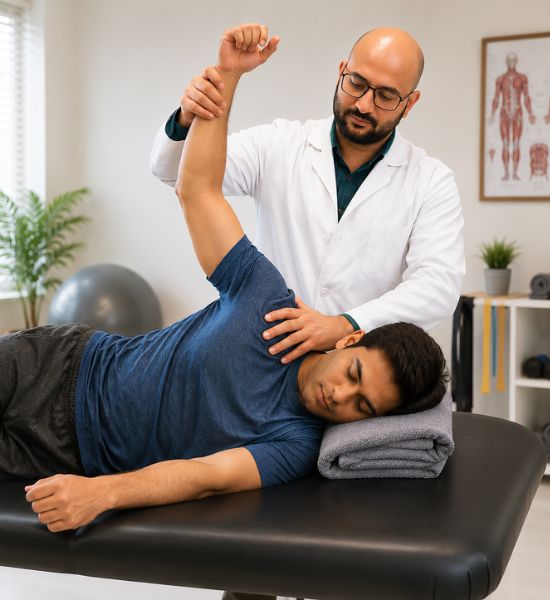
Slip Disc Treatment in Gurugram
At UM Physiotherapy, we provide evidence-based Slip Disc Treatment in Gurugram designed to reduce pain, restore spinal function, improve mobility, and help patients avoid unnecessary surgery whenever possible.
Under the guidance of Dr. Mohd Umar Mukhtar Qurashi, a Gold Medalist Physiotherapist and HCPC Registered Physiotherapist (United Kingdom), patients receive personalized rehabilitation programs based on the severity of their condition, symptoms, and lifestyle requirements.
What is a Slip Disc?
Despite its name, a Slip Disc does not actually “slip” out of place.
The spine is made up of vertebrae separated by soft discs that act as shock absorbers. These discs help the spine remain flexible while absorbing forces generated during movement.
Each disc contains:
Outer Layer
A tough fibrous ring known as the annulus fibrosus.
Inner Core
A gel-like center called the nucleus pulposus.
When the outer layer weakens or tears, part of the inner material may protrude outward. This is commonly known as a:
- Slip Disc
- Herniated Disc
- Bulging Disc
- Prolapsed Disc
When the disc material presses on nearby nerves, symptoms such as pain, numbness, tingling, and weakness may develop.
What Causes a Slip Disc?
Several factors can contribute to the development of a Slip Disc.
Poor Posture
Poor sitting posture places excessive pressure on spinal discs over time.
Prolonged Sitting
Long working hours at desks and computer work can increase spinal stress.
Improper Lifting Techniques
Lifting heavy objects incorrectly places excessive strain on the lower back.
Repetitive Movements
Repeated bending, twisting, and lifting increase the risk of disc injuries.
Age-Related Degeneration
As we age, spinal discs naturally lose water content and become more vulnerable to injury.
Sports Injuries
Athletes involved in high-impact activities may be at increased risk.
Weak Core Muscles
Insufficient spinal support can contribute to disc problems and recurring back pain.
Common Symptoms of a Slip Disc
Symptoms vary depending on the location and severity of the disc problem.
Lower Back Pain
One of the most common symptoms is persistent or recurring lower back pain.
Sciatica
Pain may travel from the lower back into the buttock, thigh, calf, or foot.
Numbness and Tingling
Patients often experience abnormal sensations in the leg or foot.
Muscle Weakness
Compression of spinal nerves may lead to weakness in the affected leg.
Difficulty Standing or Walking
Severe symptoms may interfere with mobility and daily activities.
Pain While Sitting
Many patients report increased pain during prolonged sitting.
Slip Disc vs Sciatica
Many people confuse Slip Disc and Sciatica, but they are not the same condition.
Slip Disc
A structural problem involving a damaged spinal disc.
Sciatica
A symptom caused by irritation or compression of the sciatic nerve.
A Slip Disc is one of the most common causes of Sciatica.
Learn More: Sciatica Treatment in Gurugram
Can a Slip Disc Heal Without Surgery?
One of the most common questions patients ask is:
“Do I need surgery for a Slip Disc?”
The answer is often no.
Research shows that many patients with Slip Disc, Disc Bulge, and Herniated Disc improve significantly through conservative management and physiotherapy.
Surgery may only be necessary in specific situations involving:
- Severe neurological symptoms
- Progressive muscle weakness
- Loss of bladder or bowel control
- Significant nerve compression
Most patients benefit from structured Slip Disc Physiotherapy and rehabilitation programs.
How Physiotherapy Helps Slip Disc Patients
Physiotherapy for Slip Disc is considered one of the most effective non-surgical treatment approaches.
Pain Reduction
Specialized techniques help reduce pain and inflammation.
Nerve Decompression Strategies
Specific exercises can help reduce pressure on affected nerves.
Posture Correction
Correcting posture reduces stress on spinal structures.
Core Strengthening
Strong core muscles support the spine and improve stability.
Improved Mobility
Rehabilitation restores normal movement patterns.
Prevention of Recurrence
Patients learn strategies to avoid future episodes.
Our Slip Disc Rehabilitation Approach
At UM Physiotherapy, treatment begins with a comprehensive assessment.
Your rehabilitation program may include:
Detailed Spine Evaluation
Assessment of posture, movement, flexibility, strength, and neurological function.
Manual Therapy
Hands-on treatment techniques to improve mobility and reduce pain.
Therapeutic Exercises
Targeted exercises designed specifically for your condition.
Core Stabilization Training
Improving spinal stability through structured strengthening programs.
Postural Correction
Identifying and correcting movement habits that contribute to pain.
Ergonomic Advice
Guidance for sitting, lifting, workstation setup, and daily activities.
Home Exercise Program
Customized exercises designed to support long-term recovery.
Who is at Risk of Developing a Slip Disc?
The following individuals are at higher risk:
- Office Workers
- IT Professionals
- Drivers
- Healthcare Workers
- Athletes
- Gym Enthusiasts
- Individuals Performing Heavy Lifting
- People With Sedentary Lifestyles
Early intervention can help prevent long-term complications.
Why Choose Dr. Mohd Umar Mukhtar Qurashi for Slip Disc Treatment?
Successful recovery requires more than temporary pain relief.
Professional Credentials
- Gold Medalist in Master of Physiotherapy
- HCPC Registered Physiotherapist (United Kingdom)
- Associate Team Leader – Physiotherapy at Artemis Hospital
- 10+ Years of Clinical Experience
- Certified Dry Needling Practitioner
- Certified Functional Manipulation Specialist
Specialization Areas
- Slip Disc Treatment
- Back Pain Physiotherapy
- Sciatica Treatment
- Spine Rehabilitation
- Posture Correction
- Sports Injury Rehabilitation
Every treatment plan is personalized to the patient’s condition, goals, and lifestyle.
Types of Slip Disc
Not all Slip Disc cases are the same. The severity and location of the disc injury can significantly influence symptoms and treatment requirements.
Disc Bulge
A Disc Bulge occurs when the outer layer of the disc weakens and bulges outward. While the disc remains intact, it may begin pressing on nearby structures and cause discomfort.
Disc Protrusion
In a protrusion, the inner disc material pushes outward but remains contained within the outer layer.
Disc Herniation
A Herniated Disc occurs when the inner gel-like material breaks through the outer layer and may compress surrounding nerves.
Disc Extrusion
This is a more advanced stage where disc material extends beyond its normal boundaries.
Disc Sequestration
The most severe form occurs when a fragment of the disc separates from the main disc and irritates nearby nerves.
Regardless of the stage, early Physiotherapy for Slip Disc can help improve symptoms and reduce the likelihood of long-term complications.
Common Locations of a Slip Disc
Lumbar Slip Disc (Lower Back)
The lower back is the most common area affected.
Symptoms may include:
- Lower Back Pain
- Sciatica
- Leg Pain
- Numbness
- Tingling
- Weakness
Most patients searching for Slip Disc Treatment in Gurugram are experiencing lumbar disc problems.
Cervical Slip Disc (Neck)
A cervical disc problem affects the neck region.
Symptoms may include:
- Neck Pain
- Shoulder Pain
- Arm Pain
- Tingling in the Fingers
- Arm Weakness
Learn More: Neck Pain Physiotherapy in Gurugram
Warning Signs That Should Never Be Ignored
Many patients delay treatment until symptoms become severe.
You should seek professional evaluation if you experience:
- Persistent back pain lasting more than two weeks
- Pain radiating into the leg
- Numbness or tingling
- Muscle weakness
- Difficulty standing upright
- Pain while walking
- Reduced mobility
- Recurrent episodes of back pain
- Difficulty performing daily activities
Early intervention often leads to faster recovery and better long-term outcomes.
Can Slip Disc Be Prevented?
While not every disc injury can be prevented, certain lifestyle habits significantly reduce risk.
Maintain Proper Posture
Proper sitting and standing posture helps reduce stress on spinal discs.
Strengthen Core Muscles
Strong abdominal and back muscles provide essential support for the spine.
Stay Physically Active
Regular movement improves spinal health and flexibility.
Lift Correctly
Always bend at the knees and avoid twisting while lifting heavy objects.
Maintain a Healthy Weight
Excess body weight increases pressure on spinal structures.
Avoid Prolonged Sitting
Take regular movement breaks if your work involves extended sitting.
Exercises Commonly Used in Slip Disc Rehabilitation
The right exercises can significantly improve recovery.
Depending on the patient’s condition, rehabilitation may include:
Core Stabilization Exercises
These exercises improve spinal support and reduce stress on injured discs.
Mobility Exercises
Gentle movements help restore flexibility and improve range of motion.
Stretching Programs
Stretching helps reduce muscle tightness and improve mobility.
Postural Training
Patients learn correct movement and positioning strategies.
Functional Strengthening
Exercises focus on improving daily movement patterns and physical function.
Important: Exercise selection should always be guided by a qualified physiotherapist because inappropriate exercises can worsen symptoms.
Why Some Slip Disc Cases Become Chronic
Many patients initially experience mild symptoms but later develop persistent pain.
Common reasons include:
- Ignoring early symptoms
- Poor posture
- Lack of rehabilitation
- Repeated strain
- Weak core muscles
- Sedentary lifestyle
- Returning to activity too quickly
A structured Spine Rehabilitation Program helps address these factors and prevent recurrence.
When Should You See a Physiotherapist for Slip Disc?
You should consider professional Slip Disc Treatment in Gurugram if:
- Pain lasts longer than one week
- Pain radiates into the leg
- Daily activities become difficult
- Sitting becomes uncomfortable
- You experience numbness or tingling
- You have recurring episodes of back pain
- You want to avoid long-term spinal complications
The earlier treatment begins, the easier it is to restore normal movement and function.
Frequently Asked Questions About Slip Disc Treatment in Gurugram
1. Can physiotherapy cure a Slip Disc?
Physiotherapy for Slip Disc helps reduce pain, improve mobility, strengthen supporting muscles, and restore function. Many patients achieve significant improvement without surgery.
2. How long does Slip Disc recovery take?
Recovery varies depending on severity, age, overall health, and consistency with rehabilitation. Many patients begin noticing improvements within a few weeks.
3. Is walking good for a Slip Disc?
In many cases, gentle walking can be beneficial. However, activity recommendations should be individualized based on symptoms and clinical assessment.
4. Can a Slip Disc heal naturally?
Some disc injuries may improve over time. Physiotherapy helps accelerate recovery and reduce the risk of recurrence.
5. Is surgery always required for a Slip Disc?
No. Most patients respond well to conservative management including Physiotherapy for Slip Disc, posture correction, and strengthening programs.
6. What is the best sleeping position for Slip Disc?
Sleeping positions vary by condition, but maintaining spinal alignment is generally recommended.
7. Can a Slip Disc cause Sciatica?
Yes. A Slip Disc is one of the most common causes of Sciatica because it may compress the sciatic nerve.
8. Can exercise worsen a Slip Disc?
Incorrect exercises can aggravate symptoms. Rehabilitation programs should be guided by a qualified physiotherapist.
9. Is Slip Disc common in young adults?
Yes. Modern sedentary lifestyles, prolonged sitting, poor posture, and sports injuries have increased the prevalence of disc problems in younger individuals.
10. Which physiotherapy treatment is best for Slip Disc?
The most effective treatment depends on the patient’s condition and may include manual therapy, strengthening exercises, posture correction, mobility training, and functional rehabilitation.
Related Spine Rehabilitation Services
Patients with Slip Disc often experience other spinal conditions that require specialized treatment.
Sciatica Treatment in Gurugram
Sciatica Treatment in Gurugram
Pain radiating from the lower back into the leg often requires targeted nerve rehabilitation strategies.
Chronic Back Pain Treatment in Gurugram
Chronic Back Pain Treatment in Gurugram
Comprehensive rehabilitation programs for long-standing back pain.
Neck Pain Physiotherapy in Gurugram
Neck Pain Physiotherapy in Gurugram
Treatment for cervical spine dysfunction, neck stiffness, and posture-related pain.
Cervical Spondylosis Treatment in Gurugram
Cervical Spondylosis Treatment in Gurugram
Specialized rehabilitation for age-related spinal changes in the neck.
Posture Correction Therapy in Gurugram
Posture Correction Therapy in Gurugram
Correct faulty posture and reduce stress on spinal structures.
Back Pain Physiotherapy in Gurugram
Back Pain Physiotherapy in Gurugram
Explore our complete spine rehabilitation program.
Book Slip Disc Treatment in Gurugram
Don’t allow Slip Disc, Sciatica, or persistent back pain to limit your life.
Receive expert Slip Disc Treatment in Gurugram from Dr. Mohd Umar Mukhtar Qurashi, an experienced spine rehabilitation specialist committed to helping patients recover safely and naturally.
Why Choose UM Physiotherapy?
✓ Slip Disc Specialists
✓ Non-Surgical Spine Rehabilitation
✓ Sciatica Treatment
✓ Posture Correction Programs
✓ Evidence-Based Physiotherapy
✓ HCPC Registered Physiotherapist (UK)
✓ 10+ Years of Clinical Experience
✓ Home Visit Physiotherapy Available
Schedule Your Consultation
📞 +91 87965 56680
📧 appointment@drumarmukhtar.com
📍 Sohna, Gurugram, Haryana
Take the first step toward a stronger spine, improved mobility, and lasting pain relief today.