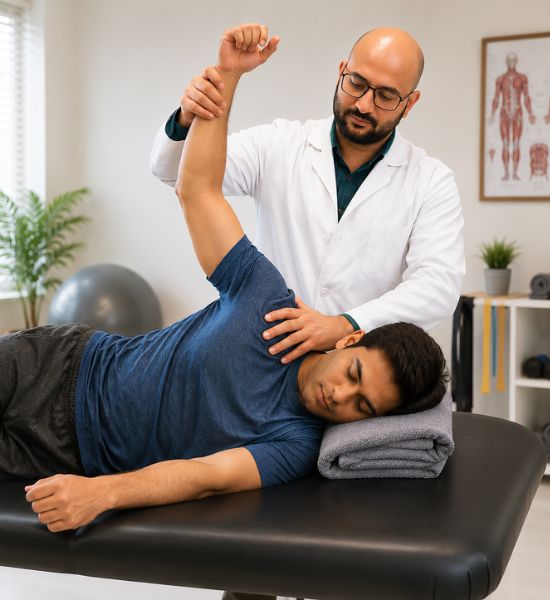
Meniscus Injury Treatment in Gurugram
At UM Physiotherapy, we provide evidence-based Meniscus Injury Treatment in Gurugram designed to reduce pain, restore mobility, improve knee function, and help patients return safely to sports and daily activities.
Under the guidance of Dr. Mohd Umar Mukhtar Qurashi, a Gold Medalist Physiotherapist, HCPC Registered Physiotherapist (United Kingdom), and Associate Team Leader – Physiotherapy at Artemis Hospital, patients receive personalized rehabilitation programs tailored to their injury and recovery goals.
What is the Meniscus?
The Meniscus is a C-shaped piece of cartilage located inside the knee joint.
Each knee contains:
Medial Meniscus
Located on the inner side of the knee.
Lateral Meniscus
Located on the outer side of the knee.
The meniscus plays several important roles:
- Shock Absorption
- Load Distribution
- Joint Stability
- Lubrication of the Knee
- Protection of Joint Cartilage
Because of these functions, maintaining meniscus health is essential for long-term knee performance.
What is a Meniscus Tear?
A Meniscus Tear occurs when the cartilage becomes damaged due to excessive force, twisting, or degeneration.
The injury may range from a small tear to a complex cartilage injury affecting knee stability and function.
Common Causes of Meniscus Injuries
Sports Injuries
Sudden twisting movements during sports are one of the most common causes.
Common sports include:
- Football
- Cricket
- Basketball
- Tennis
- Badminton
- Volleyball
Deep Squatting
Excessive knee loading may place stress on the meniscus.
Sudden Direction Changes
Pivoting movements increase injury risk.
Age-Related Degeneration
As cartilage becomes less resilient, meniscus tears may occur more easily.
Previous Knee Injuries
Patients with prior knee injuries often have a higher risk of meniscus damage.
Types of Meniscus Tears
Longitudinal Tear
A tear running along the length of the meniscus.
Radial Tear
A tear extending from the inner edge outward.
Horizontal Tear
Often associated with degenerative changes.
Bucket Handle Tear
A larger tear where a portion of the meniscus becomes displaced.
Complex Tear
Involves multiple tear patterns and often requires comprehensive rehabilitation.
Symptoms of a Meniscus Injury
Symptoms vary depending on the location and severity of the tear.
Knee Pain
Pain is usually felt along the joint line.
Swelling
Swelling may develop within hours or days after injury.
Knee Stiffness
Many patients experience difficulty bending or straightening the knee.
Clicking or Locking
The knee may catch, click, or lock during movement.
Reduced Mobility
Walking, squatting, and climbing stairs may become uncomfortable.
Knee Instability
Some patients feel as though the knee may give way.
Meniscus Tear vs ACL Injury
Patients often confuse these two common knee injuries.
Meniscus Tear
Usually affects the cartilage inside the knee.
Common symptoms include:
- Joint Line Pain
- Locking
- Clicking
- Swelling
ACL Injury
Affects one of the major stabilizing ligaments of the knee.
Common symptoms include:
- Instability
- Knee Giving Way
- Significant Swelling
- Reduced Athletic Function
Learn More: ACL Injury Rehabilitation in Gurugram
How is a Meniscus Injury Diagnosed?
Proper assessment is essential for effective treatment.
Evaluation may include:
Clinical Examination
Assessment of:
- Pain Location
- Mobility
- Strength
- Knee Function
- Stability
Functional Testing
Evaluating walking, stair climbing, and movement patterns.
MRI Imaging
MRI is commonly used to confirm meniscus injuries and identify associated knee damage.
Can Meniscus Tears Heal Without Surgery?
Many patients immediately assume surgery is required.
However, not all Meniscus Tears need surgical treatment.
The treatment approach depends on:
- Tear Location
- Tear Size
- Knee Stability
- Age
- Activity Level
- Associated Injuries
Many patients achieve excellent outcomes through Physiotherapy for Meniscus Tears.
How Physiotherapy Helps Meniscus Injuries
Meniscus Injury Treatment in Gurugram focuses on restoring knee function while protecting the healing tissues.
Treatment may include:
Pain Management
Reducing discomfort and inflammation.
Mobility Restoration
Improving knee movement and flexibility.
Strength Development
Building strength in:
- Quadriceps
- Hamstrings
- Gluteal Muscles
- Calf Muscles
Balance Training
Improving joint control and stability.
Movement Retraining
Correcting faulty movement patterns.
Functional Rehabilitation
Preparing patients for sports and daily activities.
Benefits of Meniscus Rehabilitation
Patients often experience:
- Reduced Pain
- Better Knee Function
- Improved Mobility
- Increased Strength
- Better Stability
- Reduced Swelling
- Improved Confidence
- Reduced Re-Injury Risk
Our Meniscus Rehabilitation Approach
Every rehabilitation program is individualized.
Treatment includes:
Detailed Assessment
Understanding injury severity and movement limitations.
Progressive Strength Training
Restoring muscular support around the knee.
Neuromuscular Training
Improving movement efficiency and joint control.
Functional Rehabilitation
Preparing patients for daily activities and sports participation.
Return-to-Activity Progression
Helping patients safely return to their desired level of activity.
Why Choose Dr. Mohd Umar Mukhtar Qurashi?
Professional Credentials
- Gold Medalist in Master of Physiotherapy
- HCPC Registered Physiotherapist (United Kingdom)
- Associate Team Leader – Physiotherapy at Artemis Hospital
- 10+ Years of Clinical Experience
- Certified Dry Needling Practitioner
- Certified Functional Manipulation Specialist
Expertise Includes
- Meniscus Injury Rehabilitation
- ACL Rehabilitation
- Sports Physiotherapy
- Knee Injury Rehabilitation
- Athlete Recovery Programs
- Return-to-Sport Rehabilitation
Every treatment plan is customized according to the patient’s injury, goals, and activity requirements.
Meniscus Surgery vs Physiotherapy
One of the most common concerns patients have after being diagnosed with a Meniscus Tear is whether surgery is necessary.
The answer depends on several factors, including the size of the tear, location, symptoms, activity level, and overall knee function.
When Physiotherapy May Be Enough
Many meniscus injuries can be successfully managed through Meniscus Physiotherapy without surgery.
Physiotherapy may be recommended when:
- Symptoms are mild to moderate
- Knee stability is maintained
- Daily activities are manageable
- The tear is small or degenerative
- There is no significant knee locking
Many patients regain excellent knee function through structured rehabilitation alone.
When Surgery May Be Recommended
Surgical consultation may be considered if:
- The knee repeatedly locks
- Large tears are present
- Conservative treatment fails
- There are associated ligament injuries
- Athletic demands require surgical intervention
Even after surgery, Meniscus Rehabilitation is essential for restoring strength, mobility, and performance.
Recovery Timeline for Meniscus Injuries
Recovery varies depending on injury severity, treatment approach, age, and rehabilitation consistency.
Early Phase (Weeks 1–4)
Focus Areas:
- Pain Reduction
- Swelling Management
- Mobility Restoration
- Walking Improvement
Strength Phase (Weeks 4–8)
Focus Areas:
- Muscle Strengthening
- Balance Training
- Improved Function
- Better Knee Control
Advanced Rehabilitation Phase (Weeks 8–16)
Focus Areas:
- Functional Strength
- Agility
- Running Progression
- Sports Preparation
Return to Sport Phase
Athletes gradually return to activity after meeting appropriate strength and movement criteria.
Stages of Meniscus Rehabilitation
At UM Physiotherapy, rehabilitation follows a progressive and evidence-based approach.
Phase 1 – Pain and Swelling Management
The first priority is controlling symptoms and protecting the injured tissue.
Treatment focuses on:
- Pain Reduction
- Swelling Control
- Early Mobility
- Walking Mechanics
Phase 2 – Restore Mobility
Goals include:
- Improve Knee Flexion
- Improve Knee Extension
- Reduce Joint Stiffness
- Improve Movement Quality
Phase 3 – Strength Development
Muscular strength is critical for knee protection.
Programs target:
- Quadriceps
- Hamstrings
- Gluteal Muscles
- Calf Muscles
- Core Stability
Phase 4 – Functional Training
Patients begin activities such as:
- Squatting
- Stair Climbing
- Walking Longer Distances
- Controlled Running Drills
Phase 5 – Return to Activity
Patients gradually return to:
- Gym Training
- Running
- Sports
- Recreational Activities
The progression is based on function rather than time alone.
Exercises Commonly Used for Meniscus Rehabilitation
Exercise prescription depends on the injury stage and individual assessment findings.
Quadriceps Strengthening Exercises
Strong quadriceps improve knee support and function.
Hamstring Strengthening Exercises
These muscles contribute to knee stability and movement control.
Glute Strengthening Exercises
Important for lower limb alignment and injury prevention.
Balance and Proprioception Training
Improves body awareness and joint control.
Functional Strength Exercises
Prepare patients for daily and athletic activities.
Mobility Exercises
Help maintain healthy knee movement and flexibility.
Important: Exercises should be performed under professional guidance to ensure safe progression.
Returning to Running After a Meniscus Injury
Many patients ask:
“When can I start running again?”
The answer depends on:
- Pain Levels
- Knee Strength
- Mobility
- Balance
- Functional Performance
Before returning to running, patients should demonstrate:
✓ Full Knee Range of Motion
✓ Minimal or No Swelling
✓ Good Strength
✓ Proper Movement Mechanics
✓ Confidence During Activity
Returning to Sports After a Meniscus Tear
Athletes should never return to sports simply because pain has improved.
Successful return-to-sport decisions should consider:
Strength Symmetry
Both legs should demonstrate similar strength levels.
Dynamic Stability
The knee must tolerate high-level movement safely.
Sport-Specific Performance
Athletes should successfully perform sport-specific drills.
Confidence
Psychological readiness is an important component of successful recovery.
How to Prevent Future Meniscus Injuries
Prevention is a key component of long-term knee health.
Maintain Lower Limb Strength
Strong muscles help protect the knee.
Improve Movement Mechanics
Proper movement reduces excessive joint stress.
Warm Up Properly
Prepare tissues before exercise and sports participation.
Maintain Mobility
Good flexibility supports healthy movement patterns.
Address Minor Symptoms Early
Small problems are easier to treat than major injuries.
Frequently Asked Questions About Meniscus Injury Treatment in Gurugram
1. What is a meniscus tear?
A Meniscus Tear is an injury affecting the cartilage inside the knee joint that helps absorb shock and stabilize movement.
2. Can a meniscus tear heal without surgery?
Many meniscus injuries improve significantly with structured physiotherapy and rehabilitation.
3. How long does meniscus rehabilitation take?
Recovery depends on injury severity, treatment approach, and individual factors.
4. Is physiotherapy necessary after meniscus surgery?
Yes. Rehabilitation is essential for restoring strength, mobility, and knee function.
5. Can I walk with a meniscus tear?
Many people can walk, although symptoms may vary depending on injury severity.
6. Can physiotherapy help a meniscus injury?
Absolutely. Physiotherapy for Meniscus Tears is one of the most effective conservative treatment approaches.
7. Can a meniscus tear cause knee locking?
Yes. Certain types of tears may cause clicking, catching, or locking symptoms.
8. When can I return to sports?
Return-to-sport timing depends on strength, stability, movement quality, and functional testing results.
9. Can meniscus tears occur without sports?
Yes. Degenerative tears commonly occur in non-athletes and older adults.
10. When should I see a physiotherapist?
As soon as possible after injury. Early rehabilitation often leads to better outcomes.
Related Sports Rehabilitation Services
ACL Injury Rehabilitation in Gurugram
ACL Injury Rehabilitation in Gurugram
Specialized rehabilitation for ACL injuries and post-surgical recovery.
Runner’s Knee Treatment in Gurugram
Runner’s Knee Treatment in Gurugram
Evidence-based treatment for knee pain related to running and athletic activity.
Ankle Sprain Treatment in Gurugram
Ankle Sprain Treatment in Gurugram
Comprehensive rehabilitation for ankle ligament injuries.
Hamstring Injury Rehabilitation in Gurugram
Hamstring Injury Rehabilitation in Gurugram
Recovery programs for hamstring strains and muscle injuries.
Return to Sport Rehabilitation in Gurugram
Return to Sport Rehabilitation in Gurugram
Advanced performance-based rehabilitation for athletes returning to competition.
Sports Injury Rehabilitation in Gurugram
Sports Injury Rehabilitation in Gurugram
Explore our complete sports physiotherapy and athlete recovery programs.
Book Meniscus Injury Treatment in Gurugram
A meniscus injury does not have to limit your mobility, fitness, or sports participation.
With expert physiotherapy, progressive rehabilitation, and personalized recovery planning, you can return to daily activities and sports with confidence.
Receive professional Meniscus Injury Treatment in Gurugram from Dr. Mohd Umar Mukhtar Qurashi, an experienced sports physiotherapist dedicated to helping patients recover safely and achieve long-term knee health.
Why Choose UM Physiotherapy?
✓ Meniscus Rehabilitation Specialists
✓ Sports Physiotherapy Experts
✓ Knee Injury Rehabilitation
✓ Post-Surgical Recovery Programs
✓ Return-to-Sport Rehabilitation
✓ Evidence-Based Physiotherapy
✓ HCPC Registered Physiotherapist (UK)
✓ Associate Team Leader – Artemis Hospital
✓ 10+ Years of Clinical Experience
✓ Home Visit Physiotherapy Available
Schedule Your Consultation
📞 +91 87965 56680
📧 appointment@drumarmukhtar.com
📍 Sohna, Gurugram, Haryana
Start your recovery journey today with expert Meniscus Tear Rehabilitation focused on strength, mobility, performance, and long-term knee health.