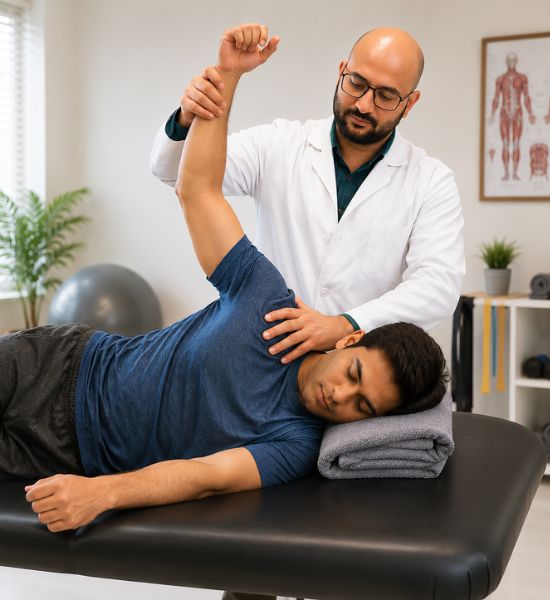
Return to Sport Rehabilitation in Gurugram
At UM Physiotherapy, we provide evidence-based Return to Sport Rehabilitation in Gurugram designed to help athletes safely transition from injury recovery to full sports participation.
Under the guidance of Dr. Mohd Umar Mukhtar Qurashi, a Gold Medalist Physiotherapist, HCPC Registered Physiotherapist (United Kingdom), and Associate Team Leader – Physiotherapy at Artemis Hospital, Gurugram, athletes receive structured rehabilitation programs focused on performance, injury prevention, and long-term athletic success.
What is Return to Sport Rehabilitation?
Return to Sport Rehabilitation is the final and most important stage of sports injury recovery.
It bridges the gap between:
- Basic Recovery
- Functional Rehabilitation
- Athletic Performance
- Competitive Readiness
The goal is not simply pain relief.
The goal is to ensure the athlete can:
✓ Train Safely
✓ Compete Confidently
✓ Perform Efficiently
✓ Reduce Injury Risk
✓ Achieve Optimal Performance
Why Returning Too Early is Dangerous
Many athletes return to sports as soon as pain decreases.
However, pain relief does not always mean full recovery.
Returning too early may lead to:
- Re-Injury
- Chronic Pain
- Reduced Performance
- Loss of Confidence
- Compensatory Movement Patterns
- Long-Term Joint Problems
This is why objective testing and structured progression are essential.
Who Needs Return to Sport Rehabilitation?
Athletes recovering from:
ACL Injury Rehabilitation
ACL Injury Rehabilitation in Gurugram
Meniscus Injury Treatment
Meniscus Injury Treatment in Gurugram
Ankle Sprain Treatment
Ankle Sprain Treatment in Gurugram
Runner’s Knee Treatment
Runner’s Knee Treatment in Gurugram
Hamstring Injury Rehabilitation
Hamstring Injury Rehabilitation in Gurugram
Rotator Cuff Injury Rehabilitation
Rotator Cuff Injury Rehabilitation in Gurugram
Tennis Elbow Treatment
Tennis Elbow Treatment in Gurugram
Golfer’s Elbow Treatment
Golfer’s Elbow Treatment in Gurugram
Sports participants of all levels can benefit, including:
- Professional Athletes
- Amateur Athletes
- Runners
- Football Players
- Cricketers
- Badminton Players
- Tennis Players
- Cyclists
- Gym Enthusiasts
Common Challenges After Sports Injuries
Even when pain improves, athletes often experience:
Reduced Strength
Injured tissues may not regain full strength automatically.
Loss of Power
Explosive movements often remain impaired.
Poor Balance
Joint control frequently declines after injury.
Reduced Confidence
Fear of reinjury can affect performance.
Altered Movement Patterns
Compensations may increase injury risk.
Reduced Endurance
Athletes may fatigue more quickly after injury.
Goals of Return to Sport Rehabilitation
A structured rehabilitation program focuses on:
Restoring Strength
Improving muscular capacity and resilience.
Improving Mobility
Restoring normal movement patterns.
Developing Power
Preparing athletes for explosive sports activities.
Enhancing Balance
Improving body control and joint stability.
Restoring Sport-Specific Skills
Preparing athletes for real-world performance demands.
Preventing Re-Injury
Reducing future injury risk through targeted rehabilitation.
Our Return to Sport Assessment Process
Every athlete undergoes a comprehensive evaluation.
Assessment may include:
Strength Testing
Evaluating muscle performance and side-to-side differences.
Mobility Assessment
Assessing flexibility and movement quality.
Balance Testing
Evaluating stability and neuromuscular control.
Functional Testing
Assessing real-world movement performance.
Sport-Specific Evaluation
Understanding the unique demands of the athlete’s sport.
Key Components of Return to Sport Rehabilitation
Progressive Strength Training
Building resilience and athletic capacity.
Agility Training
Improving reaction speed and movement control.
Plyometric Training
Preparing athletes for jumping and explosive movements.
Running Progression
For field and endurance athletes.
Direction Change Training
Essential for sports requiring cutting and pivoting.
Sports-Specific Conditioning
Preparing athletes for competition demands.
Benefits of Return to Sport Rehabilitation
Athletes often experience:
- Improved Strength
- Better Mobility
- Increased Confidence
- Reduced Injury Risk
- Improved Performance
- Better Agility
- Faster Recovery
- Safe Return to Competition
Why Choose Dr. Mohd Umar Mukhtar Qurashi?
Professional Credentials
- Gold Medalist in Master of Physiotherapy
- HCPC Registered Physiotherapist (United Kingdom)
- Associate Team Leader – Physiotherapy at Artemis Hospital
- 10+ Years of Clinical Experience
- Certified Dry Needling Practitioner
- Certified Functional Manipulation Specialist
Expertise Includes
- Sports Injury Rehabilitation
- Athlete Recovery Programs
- ACL Rehabilitation
- Performance Rehabilitation
- Return to Sport Training
- Injury Prevention Programs
Every rehabilitation plan is customized according to the athlete’s injury, sport, and performance goals.
Return to Sport Criteria
One of the biggest mistakes athletes make is returning to sports simply because pain has reduced.
Pain reduction alone does not mean the body is fully prepared for training or competition.
At UM Physiotherapy, athletes must meet specific Return to Sport Criteria before progressing to unrestricted participation.
Full Range of Motion
The injured area should demonstrate normal movement without significant restrictions.
Adequate Strength
Strength should be restored and comparable to the uninjured side.
Good Balance and Stability
Athletes must demonstrate proper body control during dynamic activities.
Functional Performance
The athlete should successfully complete sport-specific movements without symptoms.
Psychological Readiness
Confidence and trust in the injured body part are essential for successful return to play.
Strength and Performance Testing
Objective testing helps determine whether an athlete is truly ready to return.
Strength Testing
Evaluates:
- Muscle Power
- Endurance
- Symmetry
- Functional Capacity
Balance Assessment
Measures:
- Stability
- Joint Control
- Neuromuscular Coordination
Jump Testing
Often used for lower limb injuries such as:
- ACL Injuries
- Meniscus Injuries
- Ankle Sprains
- Hamstring Injuries
Agility Testing
Assesses:
- Acceleration
- Deceleration
- Change of Direction
- Sport-Specific Movement
Endurance Assessment
Ensures the athlete can tolerate training and competition demands.
The Importance of Psychological Readiness
Physical recovery is only one part of successful return to sports.
Many athletes experience:
- Fear of Re-Injury
- Reduced Confidence
- Hesitation During Movement
- Anxiety About Competition
These factors can affect performance and increase injury risk.
A successful rehabilitation program addresses both physical and psychological recovery.
Sport-Specific Rehabilitation
Every sport places unique demands on the body.
Football Players
Require:
- Sprinting
- Cutting
- Direction Changes
- Explosive Power
Cricketers
Require:
- Running
- Throwing
- Shoulder Strength
- Rotational Power
Badminton Players
Require:
- Agility
- Jumping
- Rapid Direction Changes
- Shoulder Function
Runners
Require:
- Endurance
- Efficient Running Mechanics
- Lower Limb Strength
- Load Management
Gym Enthusiasts
Require:
- Strength
- Stability
- Movement Quality
- Progressive Loading
This is why rehabilitation should always be individualized.
Injury Prevention Strategies for Athletes
One of the primary goals of Return to Sport Rehabilitation in Gurugram is preventing future injuries.
Strength Training
Strong muscles improve resilience and performance.
Mobility Training
Healthy movement patterns reduce excessive stress on joints and tissues.
Proper Warm-Up
Athletes should prepare their bodies before training and competition.
Recovery Management
Adequate recovery supports performance and injury prevention.
Load Monitoring
Sudden increases in workload significantly increase injury risk.
Movement Screening
Identifying weaknesses and imbalances before they cause problems.
Sports Performance Enhancement
Sports physiotherapy is not only about recovering from injury.
Many athletes use physiotherapy to improve performance.
Improve Strength
Better strength often leads to improved athletic output.
Improve Speed
Efficient movement helps athletes move faster.
Improve Agility
Quick direction changes are essential in many sports.
Improve Endurance
Athletes can tolerate higher training loads.
Improve Movement Efficiency
Better biomechanics improve both performance and injury resilience.
Why Athletes Trust Physiotherapy
Athletes increasingly use physiotherapy as part of their regular training.
Benefits include:
- Better Recovery
- Reduced Injury Risk
- Improved Performance
- Enhanced Confidence
- Faster Return After Injury
- Long-Term Athletic Development
Physiotherapy is no longer only for injured athletes—it is also a performance tool.
Frequently Asked Questions About Return to Sport Rehabilitation in Gurugram
1. What is Return to Sport Rehabilitation?
Return to Sport Rehabilitation is the final phase of recovery that prepares athletes to safely return to training and competition.
2. Why can’t I return to sports as soon as pain improves?
Pain relief does not always mean strength, stability, and performance have fully recovered.
3. How do physiotherapists determine readiness for sports?
Through strength testing, functional assessments, balance evaluation, movement analysis, and sport-specific testing.
4. Is Return to Sport Rehabilitation only for professional athletes?
No. Recreational athletes and active individuals benefit equally from structured rehabilitation.
5. Can Return to Sport Rehabilitation reduce re-injury risk?
Yes. One of its primary goals is reducing the likelihood of future injuries.
6. What injuries commonly require Return to Sport Rehabilitation?
Common examples include ACL Injuries, Meniscus Tears, Ankle Sprains, Hamstring Injuries, and Shoulder Injuries.
7. How long does Return to Sport Rehabilitation take?
The timeline depends on the injury, sport, performance goals, and individual recovery progress.
8. Why is strength testing important?
Strength deficits are one of the most common risk factors for re-injury.
9. Can physiotherapy improve sports performance?
Yes. Sports physiotherapy can improve strength, movement quality, agility, endurance, and efficiency.
10. When should I start Return to Sport Rehabilitation?
Typically after completing earlier phases of injury rehabilitation and receiving professional clearance.
Related Sports Rehabilitation Services
Sports Injury Rehabilitation in Gurugram
Sports Injury Rehabilitation in Gurugram
Comprehensive rehabilitation programs for athletes and active individuals.
ACL Injury Rehabilitation in Gurugram
ACL Injury Rehabilitation in Gurugram
Advanced rehabilitation and return-to-play programs for ACL injuries.
Meniscus Injury Treatment in Gurugram
Meniscus Injury Treatment in Gurugram
Specialized recovery programs for knee cartilage injuries.
Ankle Sprain Treatment in Gurugram
Ankle Sprain Treatment in Gurugram
Improve ankle stability, balance, and athletic performance.
Hamstring Injury Rehabilitation in Gurugram
Hamstring Injury Rehabilitation in Gurugram
Evidence-based rehabilitation for muscle injuries and sprint-related problems.
Runner’s Knee Treatment in Gurugram
Runner’s Knee Treatment in Gurugram
Targeted physiotherapy for knee pain affecting runners and athletes.
Rotator Cuff Injury Rehabilitation in Gurugram
Rotator Cuff Injury Rehabilitation in Gurugram
Shoulder rehabilitation focused on performance restoration and injury prevention.
Book Return to Sport Rehabilitation in Gurugram
Returning to sports after an injury requires more than just pain relief. It requires strength, confidence, mobility, performance, and a structured progression back to activity.
Receive expert Return to Sport Rehabilitation in Gurugram from Dr. Mohd Umar Mukhtar Qurashi, a Gold Medalist Physiotherapist with over 10 years of clinical experience, HCPC (UK) registration, and extensive expertise in sports rehabilitation and athlete recovery.
Whether you’re a professional athlete, recreational runner, cricketer, football player, badminton player, or fitness enthusiast, our goal is to help you return stronger, safer, and more confident than before.
Why Choose UM Physiotherapy?
✓ Sports Injury Specialists
✓ Athlete Recovery Experts
✓ Performance Rehabilitation Programs
✓ Return-to-Play Testing
✓ Injury Prevention Strategies
✓ Evidence-Based Physiotherapy
✓ HCPC Registered Physiotherapist (UK)
✓ Associate Team Leader – Physiotherapy at Artemis Hospital
✓ 10+ Years of Advanced Clinical Experience
✓ Home Visit Physiotherapy Available Across Gurugram
Schedule Your Consultation
📞 +91 87965 56680
📧 appointment@drumarmukhtar.com
📍 Sohna, Gurugram, Haryana
Take the final step in your recovery journey with professional Return to Sport Rehabilitation in Gurugram and return to competition with confidence, strength, and peak performance.